
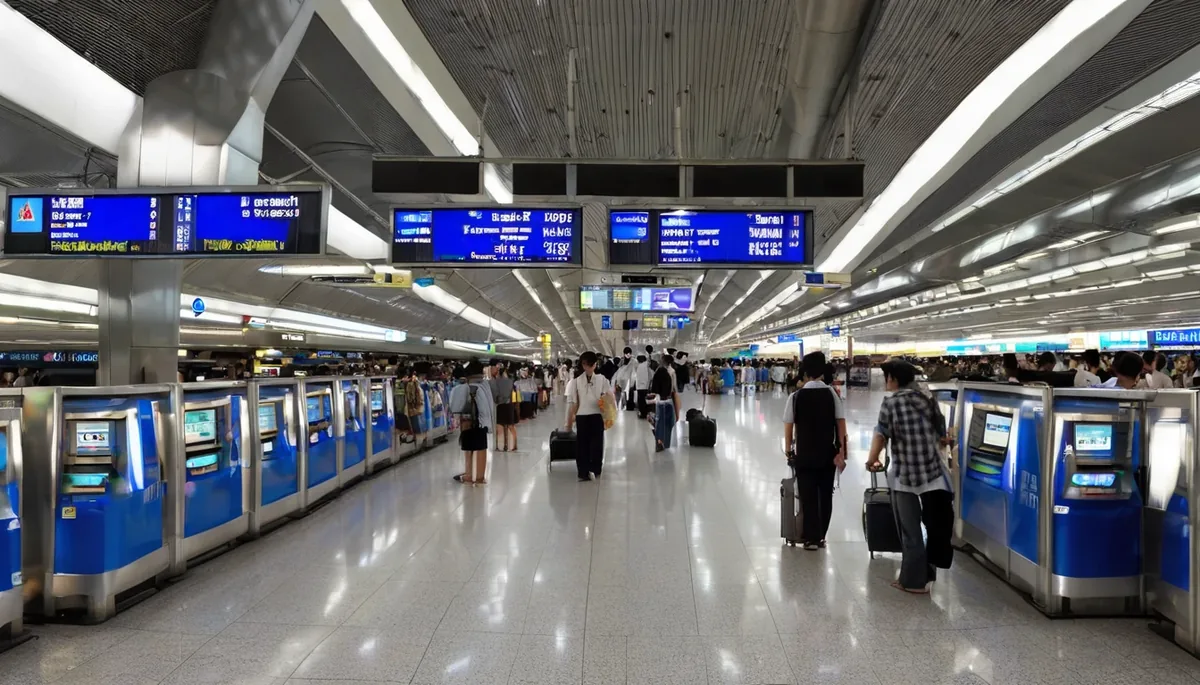
Bangkok Speed Test: BKK/DMK Airports, BTS/MRT, Old City

Blog

Bangkok Speed Test: BKK/DMK Airports, ...

Bangkok Speed Test: BKK/DMK Airports, BTS/MRT, Old City

30 Oct 2025

Bangkok Speed Test: BKK/DMK Airports, BTS/MRT, Old City

Traveller data performance in Bangkok is a story of two cities: excellent 5G in modern corridors, and uneven throughput where tourists actually linger. This bangkok mobile speed test focuses on the transit spine most visitors use—Suvarnabhumi (BKK) and Don Mueang (DMK) airports, the BTS Skytrain, the MRT, and the Old City (Rattanakosin, incl. Khao San). We ran day-vs-night comparisons across crowded windows and quieter hours. The topline: Bangkok can be blisteringly fast, but speed swings are real during peak passenger surges and at dense nightlife hotspots. Underground MRT holds steady but is rarely the quickest; BTS platforms outperform trains in motion; airport arrivals are the slowest zones you’ll hit on arrival, especially mid‑day.

This report is part of Simology’s Connectivity Lab series. We publish our raw measurements—download and upload throughput, latency, jitter and loss—as an open CSV for independent analysis. You can access methodology notes and the dataset via our Partner Hub, and browse more country snapshots on Destinations. If you’re flying onward to the US or Europe, we also link relevant eSIM options below.

How we tested (field protocol)

  • Devices: iPhone 15 Pro and Pixel 8 (dual-SIM eSIM), both 5G-capable.
  • Networks: leading Thai operators (multi-network eSIM profiles); automatic network selection enabled.
  • Tools: Ookla Speedtest app + nPerf cross-check; 3–5 runs per location per time window; medians reported.
  • Time windows:
  • Morning peak: 07:00–09:30
  • Midday: 12:00–14:00
  • Evening peak: 17:00–20:00
  • Late night: 22:30–00:30
  • Locations: BKK and DMK landside/airside zones, BTS core stations and on-train, MRT Blue/Purple platforms and in-car, Old City street-level (Grand Palace perimeter, Khao San Road, Phra Athit).
  • SIM plans: 5G bundles with high fair-use thresholds (FUPs ≥100 GB) to avoid throttling during tests.

Pro tip: - Before testing, toggle aeroplane mode for 10 seconds to refresh radio attach and clear stale sessions.

Snapshot findings (medians across operators)

  • Suvarnabhumi (BKK), main concourses:
  • Day: 120–180 Mbps down, 18–35 Mbps up, 18–28 ms latency
  • Night: 250–420 Mbps down, 25–55 Mbps up, 15–22 ms latency
  • Don Mueang (DMK), older terminals:
  • Day: 60–95 Mbps down, 12–25 Mbps up, 22–35 ms latency
  • Night: 130–200 Mbps down, 16–40 Mbps up, 18–28 ms latency
  • BTS Skytrain (platforms vs on-train):
  • Platforms (core): 140–260 Mbps day, 210–380 Mbps night
  • On-train (moving): 70–140 Mbps day, 120–220 Mbps night; brief dips during handovers
  • MRT Blue Line (underground):
  • Platforms: 80–150 Mbps day, 110–180 Mbps night
  • In-car: 55–110 Mbps day, 90–140 Mbps night; latency 25–40 ms
  • Old City (Rattanakosin incl. Khao San):
  • Day: 45–95 Mbps down, 10–20 Mbps up
  • Night (21:00–23:30): 18–60 Mbps down, 8–16 Mbps up; crowd saturation often visible

Night-time generally yields 1.6–2.2× faster downloads in airports and on BTS; the Old City is the exception—heavy evening footfall compresses capacity.

Airports: Suvarnabhumi (BKK) vs Don Mueang (DMK)

BKK highlights

  • Arrivals hall (Level 2): most congested zone. Midday medians: 90–140 Mbps down; uplink 15–25 Mbps. Night jumps to 220–320 Mbps.
  • Check-in (Level 4) and security airside lounges: consistently faster—150–240 Mbps day, 280–450 Mbps night.
  • Gate areas near outer piers (A/B/G): slight slowdowns compared with central concourses due to cell edge; expect 110–180 Mbps midday.

What this means: - Cloud check-ins, media uploads and maps updates are painless outside arrivals. If you need a big app update, do it airside or later at your hotel Wi‑Fi.

DMK highlights

  • Older building fabric and crowd bursts around low-cost departures trim speeds.
  • Landside halls: 60–90 Mbps day; 130–180 Mbps late night.
  • Airside at newer gates: modest uplift—80–120 Mbps day.

Traveller tip: - If your eSIM QR fails to activate in a packed arrivals hall, walk 100–150 metres to a quieter corner or head airside post-immigration on departure for a clean activation.

Transit corridor: BTS Skytrain

Platforms vs on-train

  • Platforms in central sections (Siam, Asok, Chit Lom): strongest performance. Day medians around 160–220 Mbps; late night 250–380 Mbps.
  • On-train in motion: handovers between cells reduce peak throughput. Day medians 80–120 Mbps; late night 130–200 Mbps.
  • Bottlenecks: river crossing near Saphan Taksin can cause quick drops; expect momentary sub‑50 Mbps dips.

Checklist: to keep signal stable on BTS - Stand near carriage windows rather than doors flanked by advertising wraps and electronics clusters. - Pause large uploads until the train stops at a station platform. - Disable Wi‑Fi assist features that hop onto weak captive portals at stations.

Transit corridor: MRT Blue and Purple Lines

  • Underground systems use in-tunnel coverage that prioritises continuity over raw peaks.
  • Platforms: 90–140 Mbps (day), 120–170 Mbps (night). Latency sits 25–35 ms.
  • In-car: 60–100 Mbps (day), 90–130 Mbps (night), with very low jitter—good for calls.
  • Uploads are the MRT’s weak spot during peaks, sometimes dipping to 8–15 Mbps at interchange stations.

Pro tip: - For video calls, MRT beats BTS during rush hour thanks to fewer handovers. Drop your video resolution to 480p/720p for consistent results.

Old City and Khao San: the tricky zone

  • Around the Grand Palace and Sanam Luang: decent mid‑day 4G/5G, 60–110 Mbps down.
  • Khao San Road and Rambuttri at night: saturation is common. We saw 18–40 Mbps down, uplink under 12 Mbps on busy nights.
  • Latency spikes (40–65 ms) and jitter can skew live streams and real‑time translations when bars are full.

Workarounds: - Step one block off Khao San to regain 2–3× throughput. - Schedule heavy uploads (drone footage, backups) outside 20:00–23:30. - If a booking app struggles at peak, toggle 5G off to force stable 4G where 5G is patchy; re‑enable later.

Day vs night: where the delta matters

  • Airports: night delivers 2× throughput on average; best time to activate eSIMs, download offline maps, or upload reels.
  • BTS: platforms show the biggest night boost; trains benefit less but still gain ~50–80%.
  • MRT: steady gains of ~40–60% at night.
  • Old City: inverse trend—night crowds reduce speeds by up to 50%.

If your itinerary is tight, time your big data tasks for late evening at your hotel or after you clear airport security.

Practical tips to stay fast

  • Pick a 5G plan with a high fair-use threshold (≥100 GB). Some “unlimited” plans throttle heavily after small caps.
  • On iOS/Android, disable Low Data/Data Saver modes during navigation or tethering.
  • Use offline maps for the Old City to avoid turn-by-turn hiccups in crowded alleys.
  • Speedtest sanity check: run two providers (e.g., Speedtest and nPerf) and take the median.
  • If tethering a laptop on BTS/MRT, cap cloud backup syncs to “paused on mobile data”.

Going beyond Thailand soon? Consider region-friendly eSIMs such as Esim Western Europe, Esim North America, or single-country packs like Esim United States, Esim France, Esim Italy and Esim Spain.

Reproduce our bangkok mobile speed test (step-by-step)

  1. Install two test apps: Ookla Speedtest and nPerf.
  2. Toggle aeroplane mode for 10 seconds; confirm 5G is available.
  3. Disable VPNs, Low Data/Data Saver and battery saver modes.
  4. Run 3 tests back-to-back, discard clear outliers (>2× from median).
  5. Move 10–15 metres and repeat to avoid a single-cell artefact.
  6. Log results with timestamp, GPS, operator, RAT (5G/4G), and note whether stationary or in motion.
  7. For train tests, mark station vs in-car and direction of travel.

Dataset fields we publish: - timestamp_utc, lat, lon, location_name, venue_type (airport/platform/train/street), operator, radio (5G/4G), download_mbps, upload_mbps, latency_ms, jitter_ms, packet_loss_pct, device, notes

Open CSV access: - Download the raw CSV and notes from the Simology Partner Hub. You can filter by venue_type to isolate airports, BTS/MRT, or Old City snapshots.

Example row (condensed, one line): 2025-02-18T12:42:00Z,13.9124,100.6068,BKK Arrivals L2,airport,AIS,5G,132.4,22.8,24,6,0.3,iPhone15Pro,midday crowd

What this means for different travellers

  • First-time visitors: don’t judge Bangkok speeds by the arrivals hall. Expect a strong uplift once you’re out of BKK/DMK or a few hours later.
  • Remote workers: MRT is the safer choice for in-transit calls. For uploads, wait for platforms or quiet hours.
  • Creators: plan story uploads for late night or hotel Wi‑Fi; shoot in the Old City, upload from Siam/Asok or back at base.
  • Teams on the move: standardise a quick bandwidth check routine. For centralised reporting and fleet eSIM controls, see Simology For Business.

For more country-by-country connectivity snapshots, head to Destinations.

FAQ

1) Is 5G widely available in central Bangkok? - Yes. 5G covers most city districts, major malls, BTS/MRT stations and both airports. Underground MRT is consistent but not the fastest; Old City at night is the patchiest.

2) Why are airport arrivals slower than departures? - Crowding, radio noise and many devices reattaching at once. Airside and higher concourses usually have better cell distribution and less interference.

3) Are BTS trains bad for video calls? - Not bad, but handovers can cause stutters. Use MRT for important calls at rush hour, or keep video to 480p/720p and turn off background uploads.

4) My “unlimited” plan feels slow—why? - Many plans throttle after a small fair-use quota. Choose high‑FUP 5G packs. If your speed drops sharply after several GB, you’ve likely hit a throttle.

5) What’s the best time to activate or switch eSIMs? - Late evening or once you’ve cleared the terminal. If activation fails in arrivals, step away from crowds or wait until you reach a less congested area.

6) I’m transiting to Europe or the US. Can I keep one eSIM? - Yes. Use a regional plan such as Esim Western Europe or Esim North America. For country-specific trips, see Esim United States, Esim France, Esim Italy and Esim Spain.

Next step: Explore more city-by-city field tests and plan your connectivity with Simology on Destinations.

Read more blogs

EU Long Stays: Fair‑Use for Nomads & Students (90/180‑Day Rule)

EU Long Stays: Fair‑Use for Nomads & Students (90/180‑Day Rule)

Planning a long stretch around Europe? Here’s the traveller‑first guide to EU fair use on long stays. Confusion often comes from mixing two different systems: immigration rules (the Schengen 90/180‑day stay limit) and telecom rules (EU roaming fair use). They are not the same. Immigration limits how long you can stay. Telecom fair use limits how long you can roam on an EU plan before surcharges kick in. If you’re a student with local residency, you’re treated differently to a roaming nomad bouncing between countries. And regional eSIMs add a third option that avoids most “home vs abroad” checks altogether. This guide cuts through the jargon with plain‑English explanations, examples you can copy, and practical checklists to keep your connectivity clean and cost‑predictable. If you just want a solution: country eSIMs are best when you settle in one place; regional EU eSIMs shine for multi‑country hops. Keep reading for the details and how to choose.The quick version: Fair‑use vs 90/18090/180 rule: Immigration. Most visa‑exempt visitors can stay in the Schengen Area up to 90 days in any 180‑day period. Nothing to do with mobile plans.EU roaming fair use: Telecom. EU/EEA operators let their customers “roam like at home” across the EU. To stop permanent roaming, they can apply fair‑use checks over a four‑month window and, if triggered, add regulated surcharges after warning you.Regional travel eSIMs: These are made for roaming. They don’t rely on EU “roam like at home” privileges, so the home‑vs‑abroad test usually doesn’t apply. Instead, your limit is the plan’s validity and data allowance.For country coverage quirks (e.g., Switzerland, UK post‑Brexit), see Destinations.What the EU fair‑use policy actually says (for travellers)EU “Roam Like at Home” (RLAH) protects EU/EEA subscribers using their home mobile plan around the bloc. It applies primarily if you hold an EU plan with an EU operator.The home‑presence and usage test (4‑month window)Your EU operator can watch usage over at least four months. If both are true, they may flag permanent roaming:1) You’ve been more time “abroad” than “at home,” and2) You used more data while roaming than you did at home.If they detect this, they must warn you and give at least 14 days to change your pattern (e.g., use the line domestically or reduce roaming). If nothing changes, they can add small, regulated surcharges on roaming usage. Your service isn’t cut off, but costs rise.Data caps on “unlimited” plans while roamingIf your domestic plan is unlimited or very cheap per GB, your operator can set a specific fair‑use roaming data allowance, calculated from your plan price and EU wholesale caps. The allowance and any out‑of‑bundle surcharge must be clearly communicated. Always read the roaming section of your tariff.Residency or “stable links”Operators can ask for proof of residency or stable links (study, work) when you buy or keep a domestic plan. This isn’t immigration control; it’s to ensure domestic plans aren’t used as permanent roaming products.Warnings and surchargesYou’ll receive a warning before any fair‑use surcharge applies.Surcharges are capped by EU rules and reviewed periodically.Paying a surcharge doesn’t fix the root cause. If your lifestyle is long‑term roaming, reconsider your setup (see below).Note: RLAH covers EU/EEA. It does not automatically include Switzerland or the UK. Check Destinations before you go.Residency vs roaming: which bucket are you in?Students with a local contract (resident or stable link)If you study in, say, France and sign up for a French mobile plan using local documentation, France becomes your “home” for that line. Your everyday use in France typically outweighs your time abroad, so your weekend trips to Spain or a fortnight in Italy sit comfortably within fair use. For deeper country fit, see Esim France, Esim Spain and Esim Italy.Digital nomads and long‑stay visitors (non‑resident)If you don’t have EU residency and you rely on a single EU domestic SIM while rarely returning to its home country, you’re likely to trip the fair‑use test after a few months. Two cleaner options:Use country eSIMs in each country you stay in for a month or two; orUse a regional travel eSIM designed for roaming around Europe.How regional eSIMs fit into long staysRegional travel eSIMs are built for cross‑border use. Instead of offering a domestic plan with RLAH, they provide roaming access in multiple countries from day one. This sidesteps the “domestic vs roaming” test entirely.Multi‑country coverage: A single profile that works across much of the EU. See Esim Western Europe for a practical one‑SIM solve when you’re rotating through EU hubs.Validity and data: Plans come with defined validity (e.g., 15–90 days) and data buckets. If you run out, top up or add another plan—no residency checks.Outside the EU: Heading to or from North America? Pair your Europe plan with Esim North America or set up before you fly with Esim United States.When you’re staying a whole term in one country, a local eSIM can be cheaper for heavy data. For multi‑country months, regional usually wins on simplicity.When to choose a country eSIM vs a regional EU eSIMChoose a country eSIM when:You’ll spend 30+ days in one country and use lots of data.You need local rates for domestic calls or long‑term top‑ups.Example pages: Esim France, Esim Italy, Esim Spain.Choose a regional EU eSIM when:You’ll cross borders frequently (e.g., 3–6 countries over 2–4 months).You prefer one number/data plan to manage across the trip.See: Esim Western Europe.Use dual‑SIM: keep your primary line for authentication calls/SMS, and set the travel eSIM as your data line.Step‑by‑step: Students (semester or year abroad)1) Get a local plan in your host country- Sign up with local ID/student proof. Your host country becomes “home” for that plan.2) Read the roaming section of your tariff- Note any roaming data caps and the four‑month fair‑use window.3) Use your host‑country SIM domestically most of the time- Weekend trips are fine. Long multi‑month trips outside your host country might trigger warnings.4) Add a regional eSIM for holiday stretches- If you’ll travel for several weeks, switch your data line to Esim Western Europe to avoid breaching your domestic plan’s fair‑use pattern.5) Keep alerts on- Don’t ignore SMS warnings. You usually get at least 14 days to adjust your usage before surcharges apply.6) Check non‑EU neighbours- UK/Switzerland often sit outside inclusive roaming. Verify on Destinations before you go.Step‑by‑step: Digital nomads (90–180 days across EU)1) Decide your pattern- Many short stays in multiple countries? Start with a regional plan. One or two long stops? Mix in country eSIMs for each stop.2) Set up before you move- Install the eSIM profile while you have reliable Wi‑Fi. Test with a small top‑up.3) Use dual‑SIM smartly- Keep your home SIM active for 2FA/texts. Set the travel eSIM as the default for data.4) Rotate plans, not penalties- Regional eSIMs like Esim Western Europe are priced for roaming and won’t run into EU “permanent roaming” tests. When staying put, switch to the local country plan (e.g., Esim Spain).5) Avoid long‑term reliance on a single EU domestic plan- If you don’t live there, the four‑month fair‑use pattern will likely catch up and add surcharges.6) Leaving or arriving via the US/Canada?- Bridge the gap with Esim North America or sort stateside coverage with Esim United States.Worked examplesStudent in France, 9 months, frequent tripsYou take a French plan as your main line. You spend most days in France, with occasional weekends in Spain/Italy. You remain well within fair use. For a four‑week summer rail trip, you add Esim Western Europe for data and keep the French SIM for calls/SMS.Nomad, 5 months, 5 countriesMonth in Portugal, then Spain, France, Belgium, Netherlands. You use a regional plan for months 1–3. For months 4–5, because you’re stationary and need more data, you add Esim Spain and Esim France during those longer stays. No EU domestic fair‑use checks apply to your regional eSIM; the country eSIMs are priced for local use when you’re settled.US visitor, 2 months in Italy with side tripsYou keep your US number active for banking but avoid pricey long‑term roaming on your domestic US plan. You install Esim Italy for the base month and add a short regional top‑up for a two‑week loop through neighbouring countries.Pro tips to stay compliant and connectedTrack days and data: set a calendar reminder every time you cross a border and use your phone’s data counter per SIM.Respect SMS warnings: they are your early‑warning system before surcharges.Prefer Wi‑Fi calling and messaging apps for cross‑border calls.Use hotspot sparingly if your plan restricts tethering.Check country exceptions on Destinations before visiting microstates or non‑EU neighbours.Business travellers: corporate pools can smooth roaming costs—see For Business or partner with us via the Partner Hub.FAQQ1: Does the Schengen 90/180‑day rule limit my mobile usage?A: No. 90/180 is immigration. EU telecom fair use is separate. You could be within your visa limit yet still trigger a roaming fair‑use surcharge—or vice versa.Q2: How long can I roam on an EU domestic plan before fair‑use kicks in?A: Operators check at least a four‑month window. If, in that period, you spend more time and use more data abroad than at home, they can warn you and later add regulated surcharges.Q3: I have an “unlimited” EU plan. Is roaming unlimited too?A: Not necessarily. Operators can set a specific fair‑use roaming data cap for unlimited/low‑cost plans and must tell you the allowance and any surcharge once you hit it.Q4: Do regional travel eSIMs have fair‑use limits?A: They’re built for roaming, so the EU “home vs abroad” test doesn’t apply. You’re bound by the plan’s validity and data bucket, plus any reasonable‑use terms (e.g., hotspot limits). For multi‑country trips, see Esim Western Europe.Q5: If I buy a French SIM, can I spend the summer in Italy on it?A: Yes, but extended, heavier use outside France could trigger the four‑month fair‑use test. For a long Italy stay, switch to Esim Italy or add a regional eSIM for the travel leg.Q6: I’m a US traveller. Should I rely on my US plan’s roaming?A: For short trips, maybe. For long stays, many US plans throttle or cap roaming after a few weeks. It’s usually better value to keep your US number for SMS and run EU data on a regional or country eSIM. Start here: Esim United States and Esim Western Europe.Next stepPlan your route, pick your coverage: explore country and regional options on Esim Western Europe, then check country specifics via Destinations.

Move eSIM to a New Android Phone (Samsung/Pixel/OnePlus)

Move eSIM to a New Android Phone (Samsung/Pixel/OnePlus)

If you’re upgrading your Android phone or carrying a new device for travel, moving your mobile plan across should be straightforward. With eSIM, that can mean either a direct device‑to‑device transfer (supported on some models and networks) or a quick reactivation using your carrier’s SM‑DP+ details or QR code. This guide explains both paths for Samsung, Google Pixel and OnePlus, and helps you decide which one to use. We’ll also cover dual‑SIM caveats that catch travellers out, and the exact situations where re‑downloading your eSIM is required. Whether you’re keeping your home number for banking OTPs and adding a travel eSIM for data, or consolidating everything on a new handset, follow the steps below and you won’t be left without service on the way to the airport. Planning a trip? Explore local and regional eSIMs on our Destinations page, including options like Esim United States and Esim Western Europe.Quick reality check: “transfer” vs “reactivate”There is no user‑accessible “export/import file” for eSIM profiles on Android due to GSMA security.Transfers work only when both devices and your carrier support the built‑in eSIM migration feature.Otherwise, you’ll reactivate on the new phone by scanning a QR code or entering SM‑DP+ details; your carrier re‑downloads the profile from their server.Keep both devices and a Wi‑Fi network handy. If your old phone is lost or broken, skip straight to the SM‑DP+ reactivation method.Before you start: compatibility and preparation checklistMake sure the following is true to avoid interruptions:Your new phone is eSIM‑capable and carrier‑unlocked.Android version: ideally Android 13 or newer (Android 14 improves transfer on Pixels).Battery ≥ 50% on both phones; connect to stable Wi‑Fi.Bluetooth enabled and both devices are nearby (for transfer).You know your eSIM’s SM‑DP+ server and activation code (check your email/order, carrier app/portal, or support). The code often looks like LPA:1$smdp.plus.example$ACTIVATIONCODE.Find your EID (eSIM ID) in Settings > About phone > Status (some carriers ask for it).If your carrier enforces “one active eSIM per number,” be ready to remove or deactivate the eSIM on your old phone when instructed—ideally only after the new one is live unless support tells you otherwise.Back up your messaging apps if needed (RCS/WhatsApp is account‑based but verify backup settings).Travelling soon? You can keep your home line for OTPs and add a travel data eSIM such as Esim North America or Esim Spain on the new device.Option A: Device‑to‑device eSIM transfer (when available)This is the easiest path when it appears. It requires support from your device, Android version and carrier. If you don’t see a transfer option, jump to Option B.Samsung (One UI 5.1 or later)On recent Samsung models, eSIM transfer is built into SIM Manager.1) On the new Samsung: - Go to Settings > Connections > SIM manager > Add eSIM. - Choose Transfer SIM or Transfer eSIM from another device if prompted.2) On the old Samsung: - When a transfer prompt appears, follow on‑screen instructions to approve the transfer. You may also navigate to Settings > Connections > SIM manager > Your eSIM > Transfer to another device if asked.3) Keep both devices unlocked, on Wi‑Fi and close together. Wait for the process to complete.Notes: - Smart Switch does not move eSIM profiles; use SIM manager transfer only. - If your carrier doesn’t support transfer, Samsung will direct you to use a QR/SM‑DP+ activation instead.Google Pixel (Pixel 6 and newer on Android 13/14)Newer Pixels offer eSIM transfer for participating carriers, especially on Android 14.1) On the new Pixel: - Settings > Network & internet > SIMs (or Mobile network) > Add SIM > Download a SIM instead. - If you see Transfer from another device, select it.2) On the old Pixel: - Approve the transfer when prompted.If the transfer option is missing or shows “No eligible SIM,” proceed with SM‑DP+ reactivation.OnePlus (OxygenOS 13/14)Most OnePlus models support eSIM but typically do not offer device‑to‑device transfer. Expect to use QR/SM‑DP+ reactivation (see Option B). If a transfer option appears on your device and carrier, follow on‑screen steps as above.Pro tips for transfersKeep mobile data off during transfer and use Wi‑Fi to avoid interruptions.If you have multiple eSIM profiles, transfer one at a time.After transfer, test calls, SMS and data. Then remove the eSIM from the old phone if required by your carrier.Option B: Reactivate the eSIM on your new phone (QR/SM‑DP+)If transfer isn’t supported, re‑download the eSIM profile from your carrier’s server.What you need: - SM‑DP+ address, activation code, and (optionally) a confirmation code. - Your EID (sometimes required to bind the profile to your new device).Generic Android steps1) On the new phone: - Open Settings: - Samsung: Connections > SIM manager > Add eSIM. - Pixel: Network & internet > SIMs > Add SIM > Download a SIM instead. - OnePlus: Settings > Mobile network > SIM management > Add eSIM. 2) Choose Scan QR code. If you don’t have a QR, pick Enter details manually and input the SM‑DP+ server and activation code from your carrier. 3) Stay on Wi‑Fi while the profile downloads. When installed, set it as your preferred line for data, calls and SMS as needed.When SM‑DP+ reactivation is requiredMoving between different brands (e.g., Samsung to Pixel, Pixel to OnePlus).Your carrier doesn’t support Android’s transfer feature.The old phone is lost, broken or wiped.You’ve changed numbers or are porting service.The profile on the old phone is locked or corrupted.Business or MDM‑managed lines where security policy blocks transfer.If your carrier limits one active eSIM per line, they may ask you to remove the old one first or will automatically suspend it when the new profile activates.Common places to find your QR/activation detailsThe original fulfilment email or order page.Your carrier or provider app.Web account portal under “Manage eSIM.”Support chat—have your EID ready.Heading to France or Italy? You can set up your travel data line in advance with Esim France or Esim Italy and activate it the moment you land.About “export/import” of eSIM profilesThere is no manual export/import file for eSIM on Android.“Transfer” is a controlled hand‑off between devices when supported.Otherwise, you “import” by re‑downloading from the SM‑DP+ server using your activation code.If anyone asks you to share an eSIM file, treat it as a red flag.Dual‑SIM and travel caveats (read before you fly)Dual‑SIM flexibility is brilliant for travellers, but a few settings matter:One data connection at a time: Android supports DSDS (dual SIM dual standby) but only one SIM can carry mobile data concurrently. Set your travel eSIM as the data SIM.Roaming control: Turn off data roaming on your home SIM to avoid surprise charges, while keeping calls/SMS on if you need OTPs.5G/VoLTE per SIM: 5G and VoLTE availability can be restricted when two SIMs are active. On some models, 5G drops to 4G when both SIMs are enabled. Test locally before you travel.Wi‑Fi Calling and RCS: These features are provisioned per SIM. If they don’t work on the new device, toggle them off/on or re‑provision by briefly switching the device to airplane mode and back on Wi‑Fi.Visual Voicemail: May require your carrier’s app or re‑provisioning on the new phone.Stored vs active eSIMs: Many phones can store multiple eSIM profiles (e.g., 5–8) but only keep one or two active at once. Name them clearly (e.g., “Home UK,” “Spain data”).Priority for calls/SMS: Choose the correct default SIM for outgoing calls and messages, or set “Ask every time” to avoid using the wrong line.Planning multiple countries? Consider a regional plan like Esim Western Europe instead of juggling several single‑country eSIMs such as Esim Spain.Troubleshooting: errors and roadblocksNo transfer option available:Update both phones to the latest software.Log into the same brand account if required (Samsung account for some transfers).If it still doesn’t appear, use SM‑DP+ reactivation.“No eligible SIM” or “Carrier not supported”:Your carrier doesn’t support transfers. Use the QR/SM‑DP+ method or contact support to unlock/reissue an eSIM.Activation fails or stalls:Use Wi‑Fi only; turn off mobile data during download.Toggle airplane mode or reboot.Clear Carrier Services app cache (Pixels/stock Android).Confirm the SM‑DP+ address and activation code characters (watch for 0/O and 1/I mix‑ups).Wait 10–15 minutes and try again—back‑end provisioning can lag.Carrier says the eSIM is “already in use”:Remove/deactivate the old profile and ask the carrier to reset/reissue the activation.Need the EID:Find it in Settings > About phone > Status > EID. Share it with support if requested.Lost or wiped old phone:Contact your carrier to revoke the old eSIM and issue new activation details. You do not need the old device to activate on the new one.If you’re setting up for a work trip and need multiple lines for staff, our team can help streamline provisioning via For Business. Partners and resellers can access tools and support via the Partner Hub.Example: setting up a travel eSIM alongside your home lineKeep your home eSIM active for calls/OTP.Add a travel data eSIM like Esim United States before you fly.On arrival, set the travel eSIM as the data SIM, keep data roaming off on your home line.Test WhatsApp/Maps and a quick speed test on Wi‑Fi first, then on mobile data.If your phone drops to 4G with two SIMs active, that’s normal on some models; if you need 5G, temporarily disable the inactive SIM.FAQ1) Can I export my eSIM profile to a file and import it on the new phone? - No. For security, Android does not allow exporting eSIM profiles to files. Use device‑to‑device transfer (if supported) or re‑activate via QR/SM‑DP+.2) Do I need my old phone present to transfer eSIM? - Only for device‑to‑device transfers. If the old phone is unavailable, ask your carrier to reissue activation details and use the SM‑DP+ method.3) Will dual‑SIM affect my 5G or battery life? - Possibly. Some phones limit 5G when two SIMs are active. Dual standby also uses slightly more power. If you need maximum speeds, disable the unused SIM temporarily.4) How many eSIMs can I store? - It varies by model (often 5–8 stored). Typically only one or two can be active at the same time. Check your device specs.5) Will WhatsApp, banking and OTPs still work after I move my eSIM? - WhatsApp links to your account, not the SIM, but ensure you keep your number and have backups. For OTPs, keep your home line active for SMS; confirm roaming is off if you want to avoid data charges.6) Does eSIM reactivation cost money? - Some carriers charge a small fee to reissue or move an eSIM. Policies vary—check your provider’s terms before you start.Where to nextSet up your travel line now so it’s ready when you land. Browse country and regional options on Destinations, including favourites like Esim United States, Esim France and Esim Western Europe.

SIM‑Swap & Account Takeover: Prevention Tips for Travellers

SIM‑Swap & Account Takeover: Prevention Tips for Travellers

Staying connected abroad shouldn’t put your identity at risk. Yet SIM‑swap fraud and account takeovers spike when people travel. Why? Attackers know you’ll be in transit, juggling time zones, relying on roaming, public Wi‑Fi and unfamiliar numbers. If they convince a carrier to reassign your number (a SIM‑swap), they can intercept SMS one‑time codes and reset your logins—often within minutes. This guide gives you practical, step‑by‑step defences you can set up in under an hour, plus what to do if you ever see suspicious “No Service” or sudden account alerts mid‑trip.We’ll focus on the highest‑impact moves for sim swap protection travel: enabling carrier account and port‑out PINs, turning on real‑time account alerts, tightening password hygiene and phishing detection, and knowing exactly when to contact your carrier. We’ll also show how travel eSIMs, used alongside your primary number, can reduce exposure without breaking your banking or messaging flows. Whether you’re off to the US, France, Italy or Spain, explore reliable eSIM options via Destinations and keep your number—and identity—yours.What is SIM‑swap and why travellers are targetedA SIM‑swap (also called port‑out fraud) happens when someone persuades your mobile carrier to move your number to a SIM or eSIM they control. Once that happens, they can: - Receive SMS one‑time passwords (OTP) meant for you - Reset email, bank, crypto, travel or social accounts - Trigger password resets using your number as a recovery method - Approve fraudulent transactions that rely on SMS codesTravellers are prime targets because: - You’re harder to reach and slower to respond to alerts - Roaming can mask “No Service” blips and strange SMS messages - You’re more likely to use public Wi‑Fi and unfamiliar networks - You may depend on SMS for banking while abroadPro tip: SIM‑swap is often the second step. The first is phishing—stealing enough info (name, number, DOB, last digits of ID) to convince a carrier. Stopping the phish often stops the swap.Before you fly: lock down your number and accountsTreat your mobile number like a bank account. These steps take 30–60 minutes and block most SIM‑swap attempts.1) Add carrier security controlsSet a strong carrier account password and memorable passcode.Enable a port‑out PIN or number lock/freeze (names vary by carrier). This prevents transfers without the PIN—even if someone knows your personal details.Turn on SIM PIN on your device. This protects your physical SIM if your phone is lost or stolen. Note: it won’t stop a remote carrier‑initiated SIM‑swap by itself.Disable or PIN‑protect voicemail, especially “reset by voicemail” features.Pro tip: Save your carrier’s fraud and international support numbers offline (notes app, paper, or password manager). If you lose service, you’ll need another line to call them.2) Move critical accounts off SMS 2FASwitch your email, cloud storage, bank, social and travel accounts to an authenticator app, hardware key or passkeys.Remove your phone number as a recovery method where possible; add a second email instead.Download and print backup codes for top accounts; store them securely.Pro tip: Your email is the “master key”. Secure it first with an authenticator or passkey before anything else.3) Turn on real‑time alertsCarrier: login attempts, SIM changes, password changes, new lines added.Email: new logins, forwarding rules added, recovery methods changed.Bank/fintech: new device logins, password changes, large transactions, payee changes.4) Upgrade password hygieneUse a password manager to create unique, 16+ character passphrases.Enable Travel Mode (if your manager supports it) to carry only what you need.Update OS and apps; enable device‑wide screen lock and Find My/remote wipe.Smarter connectivity choices on the roadUsing a travel eSIM can reduce risk by separating your data from your primary number.Keep your primary line active but restricted to calls/SMS only if you still need bank texts. Use a travel eSIM for data and apps.Alternatively, keep your primary number off (or on “no data”) and shift logins to app‑based authentication.Prefer secure messaging apps tied to your account rather than your phone number for travel coordination.Explore regional options: - United States: Esim United States - France: Esim France - Italy: Esim Italy - Spain: Esim Spain - Multi‑country: Esim Western Europe or Esim North AmericaPro tip: eSIM reduces the risk of physical SIM theft, but it doesn’t eliminate carrier‑level SIM‑swaps. Keep those carrier PINs and locks enabled.Spot the red flags: phishing and social engineering on the moveExpect tailored lures while travelling. Common examples: - “Your roaming bill exceeds $500. Verify now.” - “We’ve blocked your SIM for unusual activity. Confirm to restore.” - “Bank alert: new device login in [your destination]. Enter the code we just sent.” - Fake delivery or airline messages with urgent links - “Apple/Google/Meta: your account will be disabled. Appeal here.”How to verify safely: - Do not click links in unsolicited texts/emails. Open the carrier/bank app directly or type the URL. - Check sender details. Short codes vary by country; inconsistency is a clue. - Look for subtle misspellings, odd grammar or mismatched domains. - Treat unexpected one‑time codes as a sign someone is trying to log in as you.Pro tip: If a caller claims to be your carrier and asks for your port‑out PIN or full password, hang up and call the official number you saved earlier.When to contact your carrier (and exactly what to say)Contact your carrier immediately if any of the following occur: - Sudden “No Service” on your primary line while others have signal - Multiple “Your SIM has been changed/activated” messages - Password reset texts you didn’t request - Banks/email warn about login attempts from your home country while you’re abroadWhat to ask: - “Place an immediate freeze/number lock on my line; disable port‑out.” - “Reverse any SIM change and issue a new SIM/eSIM tied to my account.” - “Add a permanent port validation PIN on file; require it for any changes.” - “Notify me of all account changes by email and app push.” - “Confirm recent changes and provide a record of the activity.”Pro tip: From abroad, contact via carrier app over Wi‑Fi or your travel eSIM data. Keep your identity docs and account PIN ready.Step‑by‑step: If you suspect a SIM‑swap right now1) Get online another way - Use hotel Wi‑Fi, a companion’s hotspot or your travel eSIM for data. - Avoid logging in over unsecured public Wi‑Fi without a trusted VPN.2) Lock your number - Log into your carrier account; change the password and enable any number lock/port‑freeze features. - If you can’t log in, call the carrier’s fraud line and ask them to freeze/restore the line.3) Secure your “master” accounts - Change your email password; enforce authenticator or passkeys. - Review account recovery settings; remove phone number as a recovery method if safe to do so.4) Stop the financial fallout - Open your banking apps directly; review recent transactions and devices. - Temporarily freeze cards or accounts if anything looks off; call the bank from the app or listed number.5) Rotate other critical logins - Cloud storage, password manager, messaging, crypto, travel/airline accounts.6) Document and follow up - Note times, alerts, and support ticket numbers. - Ask the carrier to investigate and to keep the port‑freeze in place.After you return: keep the locks onLeave the port‑out PIN/number lock enabled permanently.Keep SMS as a last‑resort recovery only; prefer authenticators/passkeys.Review your phone number’s usage in accounts and remove where not essential.Maintain alerts on carrier, email and banking accounts.Revisit your eSIM setup for your next trip via Destinations.For teams on the move, centralise travel connectivity and security policies with For Business. Travel brands and TMCs can streamline secure eSIM distribution via our Partner Hub.Traveller checklist (quick recap)Before departure - Enable carrier account password, account PIN and port‑out PIN/number lock - Turn on SIM PIN; disable or PIN‑protect voicemail - Move key accounts to authenticator/passkeys; print backup codes - Turn on alerts for carrier, email, and bank - Update OS/apps; enable device lock and remote wipe - Save carrier fraud and international support numbers offlineWhile abroad - Use a travel eSIM for data; keep your primary number restricted if needed - Avoid SMS 2FA where possible; use app‑based approvals - Treat unsolicited links and OTPs with suspicion - Verify carrier/bank messages in their official appsIf something feels wrong - Sudden “No Service” + password reset texts = call your carrier now - Lock your line, secure email, check banks, rotate critical passwordsFAQ: sim swap protection travelQ1) Does using an eSIM stop SIM‑swap? - No. eSIM reduces physical SIM theft but carriers can still reassign your number. The real protection is carrier PINs/number locks, strong account passwords and non‑SMS 2FA.Q2) What’s the difference between a SIM PIN and a carrier port‑out PIN? - A SIM PIN protects the SIM on your device. A port‑out PIN (or number lock) is stored with your carrier and is required to move your number to another SIM/eSIM. You need both.Q3) Should I use SMS for two‑factor authentication while travelling? - Only if you must. Prefer authenticator apps, hardware keys or passkeys. If you rely on SMS (e.g., for your bank), enable carrier locks and alerts and keep your primary line reachable but tightly controlled.Q4) I’ve lost service abroad. How do I tell if it’s a SIM‑swap or normal roaming issue? - Check: do other travellers have service? Did you receive SIM change/reset texts or emails? Can you still use data on your travel eSIM? If yes to these clues, contact your carrier’s fraud line immediately and lock your number.Q5) Will a travel eSIM affect my banking texts? - No—your primary number remains your primary. A travel eSIM just handles data. You can keep the primary line active for SMS, or switch banks to app‑based approvals before travel.Q6) I’m travelling across multiple countries. What’s the simplest secure setup? - Use a regional eSIM (e.g., Esim Western Europe or Esim North America) for data, keep carrier locks on your primary number, and rely on authenticator/passkeys instead of SMS wherever possible.Next step: Plan your route and add a regional eSIM with built‑in flexibility. Explore options by country and region on Destinations.